
Stripe isn't available in your country? How to sell software to the world anyway
We make Payments via Polar (Merchant-of-record payment gateway for WooCommerce), which this article mentions where it does a step for you. Every figure here is linked to its source and dated, and we've said where other tools are a better fit.
Stripe takes card payments for businesses in about 50 countries. If yours isn’t one of them, Pakistan, Bangladesh, Egypt, Sri Lanka, Nepal, Vietnam, the Philippines and Turkey among them, Stripe’s signup simply stops. That doesn’t mean you can’t sell a plugin, an app or an ebook to buyers worldwide. It means you need someone else to be the seller.
The short answer:
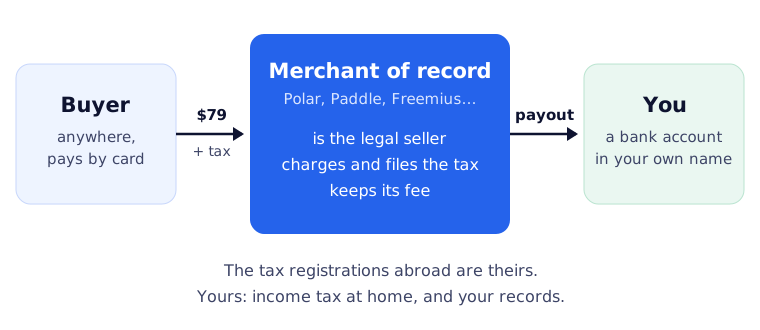
- Use a merchant of record: a company that sells your product to the buyer in its own name, charges the right VAT or sales tax, and pays you out. Polar, Paddle, Lemon Squeezy and Freemius all do this.
- Most of them pay out through Stripe, but not the Stripe you were refused: a recipient account, which receives payouts and can’t take payments. That’s available in far more countries.
- You need a bank account in your own name, in your own country. Wise, Payoneer and Revolut “virtual” accounts usually fail the payout check.
The five-minute country check
Stripe has three lists, and the one that matters to you is the third:
- Stripe’s merchant countries: where you can open a normal Stripe account and take payments yourself. Nigeria, Kenya, Ghana, Côte d’Ivoire and South Africa appear as “Extended network”, which means signing up through Paystack.
- Stripe’s cross-border payouts page, which is narrower and contradicts the next one. Ignore it for this purpose.
- The countries a US platform can pay as a “recipient”: Stripe’s own requirements data lists 121 countries, 78 of them as recipient only, including every country in the table below except Nepal. This is the rail Polar and Lemon Squeezy use.
Then check the platform’s own list. As of 18 October 2026:
| Country | Stripe account yourself | Polar payouts | Lemon Squeezy (bank) | Paddle | Freemius |
|---|---|---|---|---|---|
| Pakistan | No | Yes | Yes | Not on its blocklist | Yes |
| Bangladesh | No | Yes | Yes | Not on its blocklist | Yes |
| Nigeria, Kenya, Ghana | Through Paystack | Yes | Yes | Not on its blocklist | Yes |
| Egypt, Sri Lanka | No | Yes | Yes | Not on its blocklist | Yes |
| Vietnam, Philippines, Turkey | No | Yes | Yes | Not on its blocklist | Yes |
| Nepal | No | No | No | Not on its blocklist | Yes |
Sources: Polar supported countries, Lemon Squeezy supported countries, Paddle unsupported countries, Freemius supported countries. “Not on its blocklist” means Paddle doesn’t exclude the country; every business still goes through Paddle’s review.
If you’re in Nepal, the Stripe-based routes are closed: look at Paddle or Freemius, which pay by bank wire.
The routes, side by side
| Route | Who it suits | How you’re paid | Risk to know |
|---|---|---|---|
| Polar | Software and digital products; developers | Stripe recipient account to your own bank | Account review up to 14 days; new organisations wait 7 days before payouts |
| Lemon Squeezy | Same | Stripe recipient account, or PayPal | Being moved onto Stripe’s own merchant-of-record service, which doesn’t accept sellers from these countries (Lemon Squeezy, 2026) |
| Paddle | Established software companies | Bank wire or Payoneer | Stricter approval; sellers report rejections that come without a reason |
| Freemius | WordPress plugins and themes specifically | PayPal, Payoneer, wire or Wise | Money arrives later (see below) |
| Envato (CodeCanyon) | Reach without a store of your own | PayPal or bank transfer | A flat 50% author fee from July 2026 (reported), new author applications reportedly closed, and you don’t own the customer |
| A US company (Stripe Atlas) | Bigger sellers who want their own Stripe | A US Stripe account and US bank | $500 to start, then yearly US filings: a foreign-owned single-member LLC files Form 5472, with a $25,000 penalty per missed filing (IRS) |
What a $79 sale leaves you
A buyer in Europe pays $79 plus their VAT; the VAT goes to the tax office through the merchant of record, so it never counts as yours. From the $79, each route’s published fee for a new seller, as of 18 October 2026:
| Route | Fee on a $79 sale | You keep, before payout costs |
|---|---|---|
| Paddle | 5% + 50¢ = $4.45 | $74.55 |
| Freemius (WordPress plan) | 6.1% + 50¢ = $5.32, plus payment-processing fees | under $73.68 |
| Polar (Starter) | 5% + 50¢ + 1.5% for a non-US card = $5.64 | $73.37 |
| Lemon Squeezy | 5% + 50¢ + 1.5% international = $5.64 | $73.37, then 1% to pay out to a non-US bank |
| Envato | 50% (reported) | about $39.50 |
Then there’s getting the money home: Polar passes on Stripe’s payout charge (a $2 monthly fee plus 0.25% + 25¢ per payout), and Paddle may charge $15 for a SWIFT wire. Fees from: Polar, Paddle, Lemon Squeezy, Freemius.
On a store of your own, a cheaper route doesn’t always mean a better one. A few dollars per sale matter less than whether your country is accepted, how fast money arrives, and whether the platform can freeze it.
When the money arrives
| Route | Minimum | Schedule |
|---|---|---|
| Polar | none stated | After review; 7-day settlement for new organisations |
| Lemon Squeezy | $50 | 13-day hold, then paid on the 1st and 15th |
| Paddle | $100 | Monthly, sent by the 15th |
| Freemius | $100 | Paid on the 10th, for earnings calculated two months earlier: about 40 to 70 days after the sale |
| Envato | $50 | Paid on the 15th |
Plan your first two months of cash around these, not around your first sale.
Before you apply
Reviews look at whether your business is real and your product allowed. Have these ready:
- A bank account in your own name, in your own country. Use a business account if you sign up as a company. Polar’s docs say virtual accounts (Wise, Payoneer, Revolut) usually fail Stripe’s payout check.
- Your ID and tax number: for example, Stripe asks Bangladeshi individuals for a national ID or passport, and businesses for a TIN.
- A finished website: what you sell, its price, your terms, a refund policy and a way to contact you. A “coming soon” page gets rejected.
- The real country you live in. Every platform’s terms treat a borrowed foreign account, a friend’s details or a VPN signup as grounds to freeze the account, usually with your balance in it.
Tax, plainly
A merchant of record is the seller to your buyer, so the foreign VAT and sales-tax registrations are its job, not yours: EU VAT, UK VAT, US state sales tax. Your one sale is to the merchant of record, recorded by its payout statement or reverse invoice. What stays with you is income tax at home, any home-country rule on exported services, and keeping the records your bank will ask for.
If you’re in Bangladesh (press reports of Bangladesh Bank circulars; check the circular with your bank):
- Software and IT-enabled service exports get a 6% cash incentive in FY27, individual freelancers 2.5%, when proceeds arrive through a bank with documents (Dhaka Tribune, 6 July 2026). Whether sales through your own site, paid out by a merchant of record, qualify is something to confirm with your bank.
- ICT freelancers may keep up to 50% of export earnings in a foreign-currency (ERQ) account.
- IT and ITES income is exempt from income tax until 30 June 2027 under the Finance Act 2024, as long as it comes through a bank and you file a return. Some banks withhold tax anyway; ask yours how to claim the exemption.
- PayPal still isn’t live in Bangladesh: a July 2026 circular created a framework for it, not a launch.
How we do it
We sell our own WordPress plugins from a WooCommerce store, with Polar as the merchant of record at checkout. Buyers stay on our site, Polar charges the right tax and is the seller, and our store keeps everything else: the customer account, license keys and plugin updates. That’s two of our plugins, Payments via Polar at checkout and Sell Your Plugins for keys and updates, but the approach works with any merchant of record that has a WooCommerce integration.
Selling with Easy Digital Downloads instead of WooCommerce? Payments via Polar for Easy Digital Downloads puts Polar at EDD’s checkout, for one-time payments.
Whichever route you choose, keep a second one ready. In 2026 alone, Lemon Squeezy changed direction, Envato doubled its cut, and one payment provider’s country list quietly shrank. A backup account you’ve already been approved for turns a frozen payout from a crisis into an inconvenience.